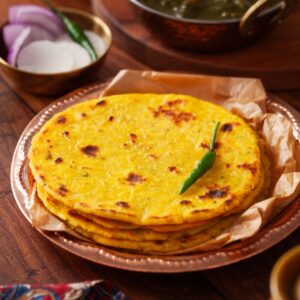
Soft Makki Ki Roti With Radish (Indian Corn meal Flatbread)
Learn how to make soft, punjabi style makki roti that are packed with a mild crunch of grated mooli (radish), and bitter sweet aroma of kaduri methi in every bite. Best enjoyed with a dollop of ghee or butter and sarson ka saag along with a small piece of jaggery.
Ingredients
- ½ inch fresh ginger
- 2 garlic cloves if they are small use 3-4
- 1 indian green chili optional, skip for kids
- 220 g makki atta super fine yellow corn meal
- 90 g mooli (daikon radish) shredded
- ⅓ teaspoon salt or to taste
- 1 teaspoon kasuri methi (dry fenugreek leaves) (crushed between palms)
- ½ teaspoon turmeric powder can reduce to ¼ teaspoon, can be skipped too, I use it only for golden color
- ⅓ - ½ cup hot water (not boiling) or as needed (I use little less than ½ cup)
Instructions
Make the Makki Atta Dough
- Place the ginger, garlic, and green chilies in a mortar and grind them into a smooth paste using the pestle.
- In a large mixing bowl, add the sifted makki atta.
- Add the grated radish, ginger-garlic-chili paste, crushed kasuri methi (dry fenugreek leaves), salt, and turmeric powder to the bowl. Tip - Before adding the radish,taste the radish to make sure that they are not bitter else taste of your roti will be spoiled.
- Using your hands, mix the ingredients thoroughly into the makki atta.As soon as the salt and radish come into contact, the radish will begin releasing its water, which the flour will start absorbing.
- Gradually start adding warm water, a little at a time, and mixing it with the flour.
- Now you will have to go by how atta feels - add little water slowly as needed and bring the flour together. Keep in mind that the radish will still continue to release its moisture so the dough will get softer as it sits.
- Once there is no dry flour remaining, start smoothening the dough using the palm of your hand as you knead. This a bit tedious step and could take 6-8 minutes. You will yield a soft dough. The dough should not be sticky.
- Set aside the dough for 15-20 minutes. Not needed but I have a habit of resting any sort of dough so I do the same here.
Shape or Roll The Makki Roti (USE ANY 1 METHOD BELOW)
- Method 1 - Tortilla Press And Parchment Paper1)Line the base of a tortilla press with a sheet of parchment paper.Smear the parchment paper with few drops of oil. 2)Place a ball of dough in the center and add few drops of oil on top of the dough ball.Cover it with another parchment sheet.3)Close the tortilla press and apply firm pressure, pressing 2-3 times or as needed to flatten the dough into a ¼-inch thick roti. The edges of the rotis are going to be cracked unlike the roti made of wheat flour.4)Simultaneouly you can start cooking the rotis on a heated griddle (instructions below).
- Method 2 - Rolling Between Parchment Paper1)On a flat rolling surface or a rolling stone, place a sheet of parchment paper.Smear the parchment paper with few drops of oil.2)Place a dough ball in the center and drizzle a few drops of oil on top of dough ball.Initially, flatten and spread the dough using your fingers in a circular motion to form a 2 to 3 inch circle. Keep in mind to not rotate the roti, rather rotate the parchment paper as needed to flatten out the roti on all sides.3)Cover the dough circle with another parchment sheet.Using a rolling pin, without applying too much pressure, roll the roti out 2-3 times to flatten it more. I do not make very big rotis - about a 4-5 inch circle.
COOK THE ROTI
- Heat up a heavy tawa or cast iron pan on medium heat.
- Lift the top piece of parchment paper and carefully place the rolled roti upside down on the hot tawa.
- Peel off the second sheet of parchment paper. Cook the roti for about 30-45 seconds, or until it slightly darkens in color.
- Using a flat spatula, flip the roti and brush a oil or ghee(1-2 teaspoon) on the cooked side. After 30-40 seconds, flip again.
- Repeat the process, brushing oil or ghee on other side. Cook until the roti is evenly cooked and has brown spots on both sides.
- Shape and cook all the remaining rotis in this way until the dough is exhausted.
- Serve hot makki ki roti topped with a dollop of butter with sarson ka saag, sliced onions & chilies and a small piece of jaggery.
Video
Notes
- Use fine ground maize flour for making these flatbreads. It is different from cornmeal that you will find in our super market.
- Make sure that the flatbread dough is soft but not sticky. Since maize flour is dense, it does need moisture for soft rotis but at the same time, if the dough is not firm, you won‘t be able to shape it or it will break during lifting.
- Knead the dough using hot water. The water should not be lukewarm or boiling but and be okay to touch. Hot water is absored by the flour easily and makes for soft rotis.
- One additional step while kneading the makki dough is to knead portions of it using the heel of your hand along with your knuckles. This process, traditionally called “atta chikana karna” (smoothening the dough), is a crucial step and takes about 6-8 minutes. It helps achieve a pliable dough,and ensures that your makki rotis won’t break while shaping or cooking. Take your time with this step for the best results!
- Keep the roti medium-thick. If its too thin, it crisps up and might break; too thick and it will remain raw inside.
- Cook the rotis on medium heat. If you cook them on low heat, it takes long to cook through and they dry up in the process (been there, done that!). High heat will make them nicely spotted on outside but the insides might remain raw(have experience with this too!).
- Maize flour can taste quite dry if you skimp on oil or ghee or butter. Whether you are spreading oil on rotis while cooking or smearing ghee or butter after the rotis have cooked, be generous!
- Lastly, if you do not want to use shredded mooli, you can skip it. In that case you will have to increase the water quanity a little while kneading the dough.
Tried this recipe?Let us know how it was!